The Great AI Repatriation: Why 3,858 Companies Moved AI Inside Their Perimeter Last Week
Discover why 3,858 companies per week are migrating from public SaaS AI to self-hosted architectures. Explore how Queristo’s turnkey deployment framework brings secure AI to your private cloud in weeks.
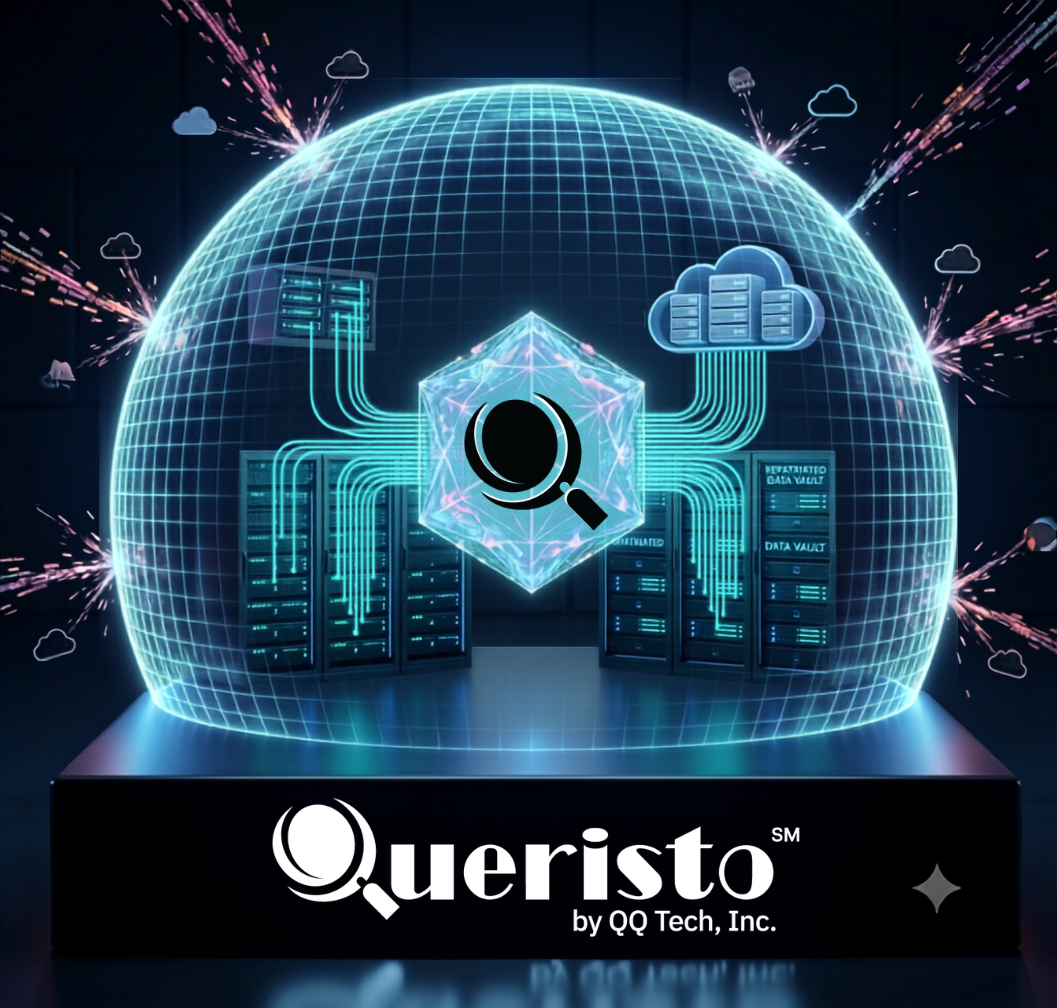
In a single week, a staggering 3,858 companies moved their artificial intelligence workloads inside their secure operational perimeters. Far from an isolated spike, this data point marks the acceleration of a massive structural realignment currently unfolding in global enterprise IT architectures.
According to the groundbreaking report, "Global Architectural Repatriation: A Quantitative Analysis and Estimation of Weekly Enterprise Conversions from Public Conversational AI to Self-Hosted Infrastructures," the initial wave of relying on multi-tenant, public cloud SaaS AI tools is rapidly giving way to a localized, self-hosted reality. Driven by economic mandates, severe data leakage concerns, and strict regulatory frameworks, thousands of organizations are pulling their AI workloads out of public view and placing them securely inside their internal networks.
Deconstructing the Math: Who is Moving Inside the Perimeter?
The global migration is happening across all business sizes, but the velocity and strategic motives differ by market segment. The quantitative model developed in the report aggregates global telemetry across three key cohorts to arrive at the weekly conversion velocity of 3,858 companies:
This translates to over 200,000 corporate migrations annually. Cloud security telemetry heavily supports these findings, indicating that 90% of observed cloud environments now run self-hosted AI software, with 63% of organizations actively choosing a self-hosted architecture for their large language models (LLMs).
The Core Catalysts Behind the Migration Wave
1. The DeepSeek Disruption & Open-Weight Economics
Historically, public SaaS models held a monopoly on performance. The arrival of frontier-level open-weight models, most notably DeepSeek-R1, shattered this capability gap. DeepSeek-R1 tripled its self-hosted adoption rate in less than two weeks. Because open-weight models allow organizations to download and run intelligence locally, they bypass premium token markups. Findings from the a16z AI Infrastructure Report show that switching from closed, proprietary APIs to self-hosted open-source models at scale yields an average cost reduction of 86%.
2. Eradicating the Shadow AI Epidemic
Security telemetry reveals that 45% to 50% of enterprise employees use generative AI at work—and over 75% of them actively copy and paste corporate information into public chatbots. This has led to an epidemic of "Shadow AI," exposing sensitive source code, corporate financial data, and PII. In fact, 20% of surveyed organizations have suffered an AI-related data breach.
Rather than completely blocking these productivity tools, global leaders are opting to "Build, Don't Block." They are deploying self-hosted, internally controlled alternatives:
- Financial Institutions: Wall Street giants like JPMorgan Chase, Deutsche Bank, Wells Fargo, Bank of America, Citigroup, and Goldman Sachs implemented blanket bans on public ChatGPT access, choosing isolated internal pipelines and custom compliance setups (e.g., Morgan Stanley's secure internal LLM).
- Tech Giants: Apple, Samsung, Verizon, LG, and SK Hynix clamped down on employee use of public platforms following high-profile data leaks involving proprietary source code.
- Healthcare Networks: Major systems like the Mayo Clinic, Cleveland Clinic, and Kaiser Permanente restricted public AI in favor of HIPAA-compliant, self-hosted clinical models.
- Professional Services: The Big Four accounting firms deployed proprietary, self-hosted environments—Deloitte’s Zora, EY’s EYQ, PwC’s ChatPwC, and KPMG’s KymChat—to guarantee absolute client confidentiality.
Compliance, Sovereignty, and the "Control-First" Cloud
A primary accelerator of this movement is a rigid web of legal mandates that took full effect in 2025 and 2026. Under the Digital Operational Resilience Act (DORA), financial institutions must maintain absolute auditable control over their IT operations. The impending EU AI Act (August 2026) imposes harsh penalties—up to 7% of global turnover—for non-compliant high-risk AI usage, making opaque, multi-tenant SaaS architectures a regulatory nightmare. Additionally, the EU Data Act enforces strict digital sovereignty and vendor portability.
As a result, cloud strategies are shifting from "public cloud first" to "control first." Gartner indicates that over 65% of enterprises building AI models prefer private or hybrid cloud environments. Furthermore, the Barclays CIO Survey states that 83% of enterprises plan to repatriate workloads from public clouds back to private cloud infrastructure to establish total data sovereignty and predictable cost controls.
Securing the New Perimeter
While moving AI inside your perimeter eliminates external public cloud data exposure, self-hosting is not a silver bullet without aggressive security governance. As organizations spin up local instances, they must safeguard against infrastructure flaws like the Probllama vulnerability (CVE-2024-37032) in Ollama, the DeepLeak exposure, and the NVIDIA AI vulnerability (CVE-2024-0132), which affected over 35% of cloud-based AI environments via container escapes.
Furthermore, the Wiz 2026 report highlights the rise of "Transitive AI," showing that while 90% of environments run self-hosted AI, 68% of these organizations ingest their models indirectly through third-party enterprise software updates. This unmapped AI footprint bypasses traditional asset inventories, making rigorous infrastructure posturing, Model Context Protocol (MCP) guardrails, and secure control planes absolutely critical.
Conclusion: Take Control of Your AI Architectural Future
The numbers speak for themselves. The migration to self-hosted AI is no longer a luxury choice—it is the modern standard for securing mid-market corporate assets. By moving AI inside your perimeter, you protect your intellectual property, guarantee compliance with strict regulations like DORA and the EU AI Act, and eliminate unpredictable public cloud vulnerabilities.
Queristo provides the definitive pathway to make private infrastructure deployment painless. By handling the complexities of local installation, configuration, and optimization through our turnkey deployment framework, Queristo empowers your business to scale its internal AI operations safely, eliminate data leakage risks, and maintain full data sovereignty.
Don't let your sensitive corporate data leak into public multi-tenant clouds. Take control of your AI infrastructure today without the typical IT delays.
Ready to securely bring AI inside your perimeter? Visit www.Queristo.com to build your custom deployment quote today.
-custom-ai.png)